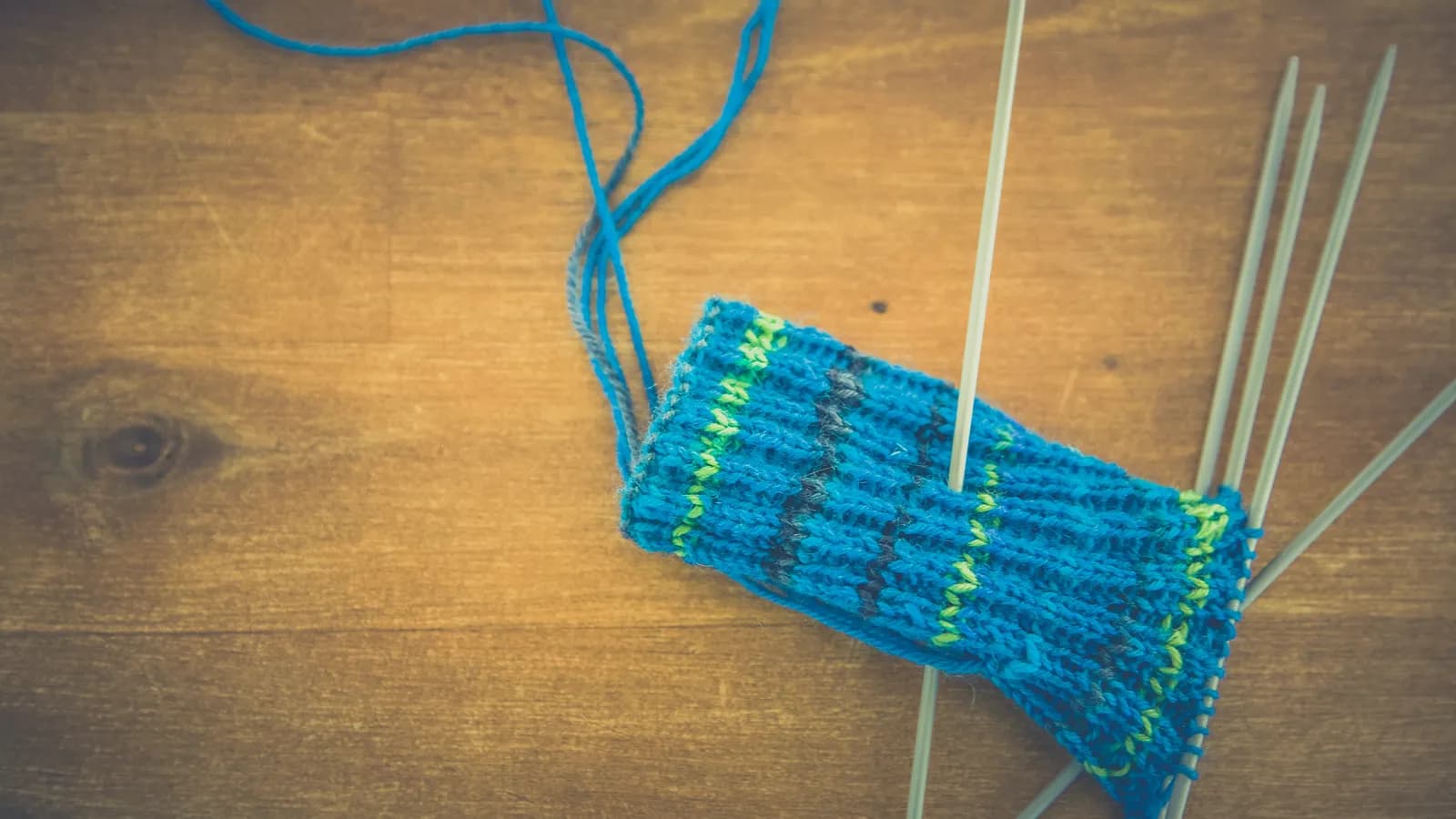
You read a knitting pattern from the top down. Start with the materials and gauge, then find your size, then check the abbreviation key, and only then begin the rows. Repeats sit between asterisks or brackets and tell you to work the same stitches again. The sections below follow that order, and you can keep them open beside your needles. The reading patterns guides collect the rest.
What do you check before you cast on?
Check the materials, the gauge and your size before you cast on a single stitch. Lion Brand's guide suggests confirming five things: the materials and gauge, your size, the abbreviation key, and whether the pattern uses a chart, written instructions or both.
Materials. Confirm that the yarn weight, the yardage and the needle size match what you have. Materials appear before the instructions, so you can check them before you buy.
Gauge. Gauge is the number of stitches and rows over a set measurement, usually 4 inches. It decides whether the piece will fit. Knit a swatch a little larger than the measured area so you can measure in the stable middle, and block it the way you will treat the finished piece. Measure before and after blocking. If your stitches come out too tight, go up a needle size. If they are too loose, go down.
Your size. Designers usually list the smallest size first, with the larger sizes in parentheses or after slashes. Tin Can Knits gives this example: "cast on 66 (72, 78, 84, 90, 96) sts". You find the number in your size's position and use only that one. The same layout applies to lengths and numbers of repeats, so highlight your size everywhere it appears before you begin. A schematic, the line drawing with labelled measurements, shows where each instruction lands on the piece.
What do the abbreviations mean?
Abbreviations are shorthand that saves space, and most American patterns follow the Craft Yarn Council's standard list. A few you will meet in almost every pattern:
| Abbreviation | Meaning |
|---|---|
| k | knit |
| p | purl |
| CO | cast on |
| BO | bind off |
| yo | yarn over |
| inc / dec | increase / decrease |
| k2tog | knit two together |
| rep | repeat |
| RS / WS | right side / wrong side |
For a closer look at one of them, see how to knit two together (k2tog) step by step.
Two habits help. Read the pattern's own glossary: a definition printed in the pattern wins over any general list. And use context when a term could mean two things. Vogue Knitting's list notes that BO appears as both "bind off" and "bobble", so the surrounding line tells you which one is meant.
How do you read rows, sides and repeats?
Work the rows in numbered order, and watch for the side. Row 1 is often the right side (RS) and Row 2 the wrong side (WS). Flat pieces are worked back and forth in rows. Tubes, such as hats and socks, are worked in rounds, and a crocheter will recognise that rhythm of rounds too. "Work even" means keep going in the established stitch pattern with no increases or decreases.
Take a made-up line: "Row 12 (RS): k2, k2tog, seed st to last 4, ssk, k2". Read it left to right. You are on a right side row. You knit 2, knit two together, work seed stitch until 4 stitches remain, slip, slip, knit, and knit the last 2.
Repeats come in three shapes:
- Asterisks. "*K2, p2; rep from * to end" means work k2, p2 over and over until the row is finished.
- Brackets with a number. "[yo, k2tog] 6 times" means six yarn overs and six k2tog, one after the other.
- Parentheses. "(k1, p1, k1) in next st" means all three stitches go into the same stitch.
Written rows and charts say the same thing in different ways. Lion Brand's guide notes that a chart reads from the bottom up. On flat work, right side rows read from right to left and wrong side rows from left to right, while in the round every row reads right to left. Always check the chart key first, because symbols vary by designer and a purl symbol on a right side row usually means knit on the wrong side.
Some repeats run "around", "to end" or "to next marker" instead of a number. Designers differ, so check each pattern's conventions. If your row has to come out even, do a quick check: divide your stitch count by the repeat length, and count any edge stitches too. A 4-stitch repeat over 32 stitches runs 8 times with nothing left over. Stitch markers between repeats make a miscount show up early. If you also crochet, how to read a crochet pattern covers the same ideas for hooks.
How do you keep your place while you work?
Mark where you are every time you put the work down. It takes a second. A row counter, a highlighter on a printed copy or a sticky note above the current row all work. Note the row you stopped on, and write the size you are following at the top of the page so you never have to hunt for it.
Try it in Row & Round
Row & Round is coming soon to iPhone, iPad and Apple Watch. Its highlighter bar sits on the row you are working in your PDF pattern and shows the few lines around it, so you can look up from the needles and find your place again. Each tap on +1 moves the bar to the next row, and the bar says right side or wrong side.
Bottom line
Read from the top: materials and gauge, your size, the abbreviation key, then the rows. Highlight your size, trust the pattern's own glossary, and treat repeats as small instructions with a count you can check.
Questions
- Which size do I follow when the numbers are in parentheses?
- The first number belongs to the smallest size and the rest follow in parentheses. Find the position of your size and use only that number. Highlighting your size everywhere it appears before you start keeps you from drifting to the wrong one.
- What does rep from * to end mean?
- Work the stitches after the asterisk again and again until the row runs out of stitches. If the last few stitches are not enough for a full repeat, the pattern tells you what to do with them, such as end k2.
- What does work even mean?
- Keep going in the stitch pattern you have set up, with no increases or decreases. The stitch count stays the same.
- Do I really need to swatch?
- If the finished piece has to fit, yes. Gauge decides the size. Knit a swatch with the yarn and needles the pattern names, block it the way you will treat the finished piece, then measure before and after blocking.