Pebble Path Dishcloth: Free Dishcloth Knitting Pattern
This free dishcloth knitting pattern makes a square cloth in seed stitch with a garter border. You work it in worsted cotton on US 7 (4.5 mm) needles, and it measures about 8 × 8 in (20 × 20 cm). Every row of the centre is the same.
- Knitting
- Beginner
About this pattern
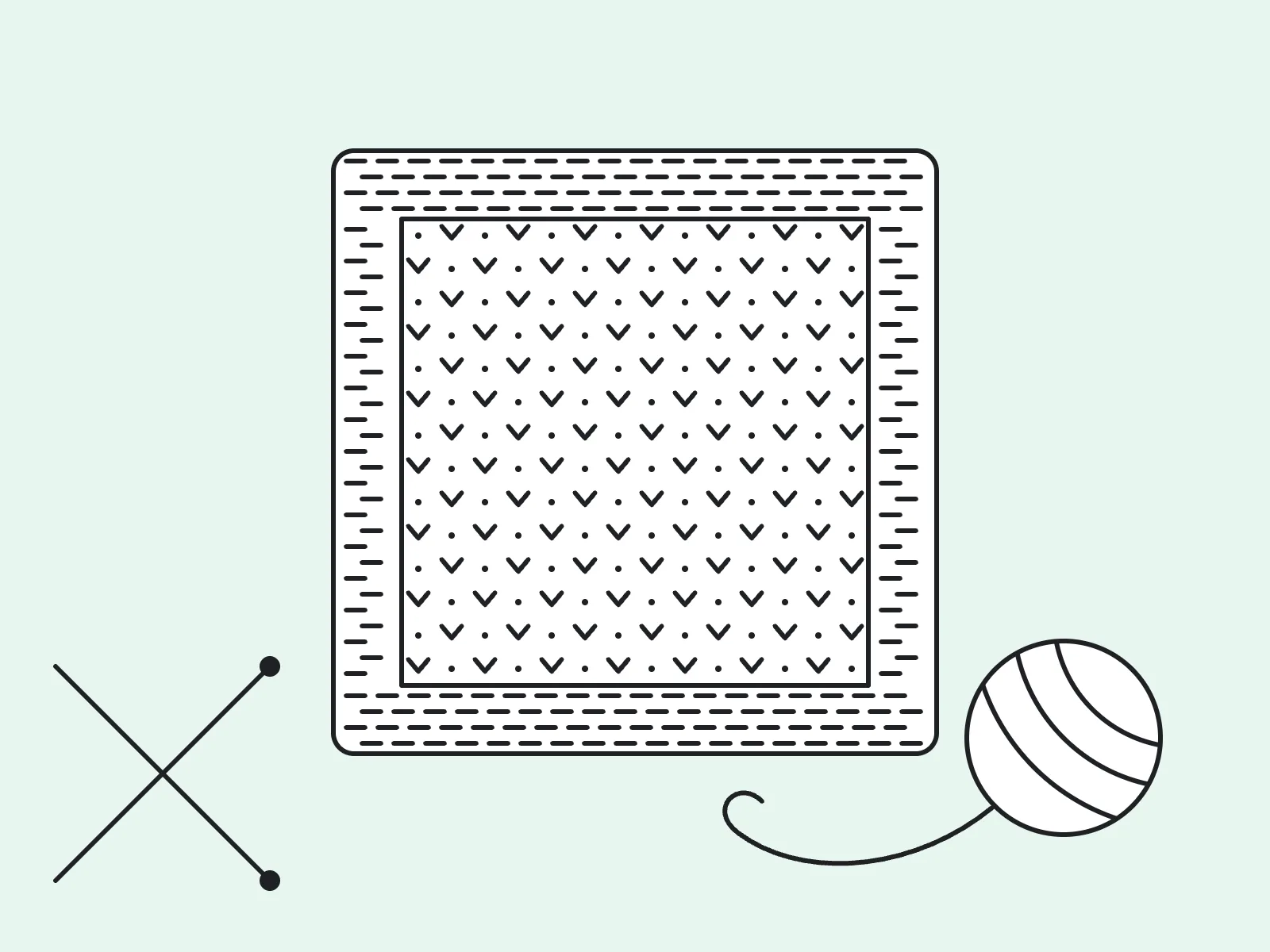
An 8 in (20 cm) square cloth in seed stitch with a garter border, in worsted cotton (about 90 yds). 64 rows on one page.
1 page, US Letter, prints in black and white. The pattern is written in English.
© 2026 Row & Round · Free for personal use
What you'll make
The Pebble Path Dishcloth is a square knitted dishcloth in seed stitch with a garter border. Seed stitch gives the centre a bumpy, pebbled texture. The garter border keeps the edges neat and flat.
It is a free pattern for personal use. The complete written instructions are on this page, so you can knit straight from them. It is a calm first project and a quick gift.
Is it right for a beginner?
Yes. This is an easy knitting pattern for beginners. You only need to knit and purl, and there is no shaping: no increasing and no decreasing.
The border is plain knitting, 4 rows at the start and 4 rows at the end. The centre is one row, repeated. Once you have worked it twice, you know it.
Seed stitch can look fiddly in photos. In practice you knit the knits and purl the purls as they face you, and the stitches take care of the rest. That makes a seed stitch dishcloth a good place to practise switching between knit and purl.
You will cast on, knit, purl, bind off and weave in your ends. That is every skill in the pattern, and it is a good set to have before you move on to a hat or a scarf.
What you need for a cotton dishcloth
Here is everything you need. One ball of yarn is enough, so the list for a cotton dishcloth is short.
You can use straight or circular needles. Both work, so use whichever you already have in the size.
- Yarn: worsted-weight (#4) 100% cotton, about 90 yds (82 m), one ball.
- Needles: US 7 (4.5 mm) straight or circular needles.
- Notions: tapestry needle, scissors.
Size and gauge
The finished cloth is about 8 × 8 in (20 × 20 cm). That is a square, the same size across and down.
Gauge is 18 sts and 32 rows = 4 in (10 cm) in seed stitch. Gauge is not critical for a dishcloth. A different gauge changes the size and the yarn used, so a tighter or looser cloth will take a little less or a little more than the 90 yds listed above.
If you want a cloth close to 8 in, knit a small swatch in seed stitch first and measure it against the gauge.
Abbreviations
The pattern uses only a few. Here is what each one means.
- k: knit
- p: purl
- rep: repeat
- RS / WS: right side / wrong side
- st(s): stitch(es)
- *: repeat the instructions after the * as directed
The free dishcloth knitting pattern, row by row
Cast on, work the first border, the centre and the second border, then finish. There are 64 rows in all: 4 border rows, 56 centre rows and 4 border rows. Here are the instructions exactly as they are in the PDF.
- Cast on 37 sts.
- Border. Rows 1–4: Knit.
- Centre. Rows 5–60: K4, *p1, k1; rep from * to last 3 sts, k3.
- Border. Rows 61–64: Knit.
- Finishing: Bind off all sts knitwise.
- Finishing: Weave in the ends. Wash, lay flat to dry, and gently pull it square.
How seed stitch works and how to read your stitches
Every row of the centre is worked the same way: knit the knits and purl the purls as they face you, and the little bumps line up into seed stitch. That is the whole idea.
Read the centre row in three parts. K4 at the start and k3 at the end are the garter edge stitches, so the sides lie flat like the border. Between them, p1, k1 repeats across the row.
The part that trips people up is the switch from purl to knit. Bring the yarn to the front before you purl and take it back before you knit. Go slowly for a few rows and it becomes a rhythm.
Both sides look the same, so either side can be the right side. You do not need to keep track of which side is facing you, and you can pick the work up again at any point without losing your way.
Tips for knitting it
A few small things make the cloth neater and the knitting calmer.
- Check your cast-on. You need 37 sts before you begin Row 1.
- Keep the edges even. Every row of the centre starts with k4 and ends with k3, which matches the garter border.
- Count the 64 rows. The first border is Rows 1 to 4, the centre is Rows 5 to 60, and the second border is Rows 61 to 64.
- Do not worry about gauge. A different gauge only changes the size and the yarn used.
- Block it the way the pattern says: wash, lay flat to dry, and gently pull it square.
- Weave in the ends with the tapestry needle.
- Start each centre row slowly: k4, then straight into p1, k1. After a few rows your hands learn it.
Following it in Row & Round
Row & Round is an iPhone and iPad app that keeps your place in knitting and crochet patterns. Open this pattern's PDF in Row & Round and a highlighter bar sits on the row you are working. Tap +1 and the count and the bar move together.
That helps with a seed stitch dishcloth, where every centre row looks like the last. You can look up from your stitches and find your place again at a glance. Undo is always one tap away, and your place is saved on every tap.
Row & Round can also link a pattern row to a repeat and set an alert for every 6th row. You will not need those here, but they are there for the next pattern.
For this cloth, the count is simple. It runs from Row 1 to Row 64, and the bar shows you which of the 56 centre rows you are on.
Gift ideas
A knitted dishcloth makes a quick gift. Tuck one in with a bar of soap.
Because you only need one ball of cotton and the pattern stays the same each time, it is easy to make more than one. Keep the same yarn for a matching set, or change the colour for each cloth.
Questions
- What yarn do I need for a cotton dishcloth?
- Worsted-weight (#4) 100% cotton, about 90 yds (82 m), one ball. You also need US 7 (4.5 mm) needles, a tapestry needle and scissors.
- How big is the finished knitted dishcloth?
- About 8 × 8 in (20 × 20 cm). Gauge is 18 sts and 32 rows = 4 in (10 cm) in seed stitch.
- How many stitches and rows are there?
- You cast on 37 sts and work 64 rows: 4 rows of garter border, 56 rows of seed stitch centre, then 4 more rows of garter border.
- Is this an easy knitting pattern for beginners?
- Yes. It uses only knit and purl stitches, with no shaping. Every row of the centre is the same, so it is a calm first project.
- How much yarn does it use?
- About 90 yds (82 m) of worsted-weight cotton, one ball. A different gauge changes the size and the yarn used.
- Does gauge matter?
- Not much. Gauge is not critical, and a different gauge changes the size and the yarn used.
- Can I use either side as the right side?
- Yes. Both sides look the same, so either side can be the right side.