Footpath Socks: A Free Sock Knitting Pattern, Cuff Down
This free sock knitting pattern makes classic cuff down socks in fingering-weight yarn: a ribbed cuff, a plain leg, a slip-stitch heel flap, a turned heel, gusset decreases and a wedge toe closed with Kitchener stitch. Every row of the heel is written out.
- Knitting in the round
- Intermediate
About this pattern
Classic cuff-down socks in fingering-weight sock yarn: ribbed cuff, plain leg, slip-stitch heel flap, turned heel, gusset decreases and a wedge toe closed by grafting. One size (8 in around), foot about 9½ in, with notes for changing the length. About 380 yds for the pair. 188 rows and rounds, two pages.
2 pages, US Letter, prints in black and white. The pattern is written in English.
© 2026 Row & Round · Free for personal use
What you'll make
Footpath Socks are plain, sturdy socks with the classic heel. You start at the top with a k2, p2 ribbed cuff, knit a plain leg, then shape the heel, the gusset and the toe.
It is a free pattern for personal use, and the complete written instructions are on this page. The pattern is one size: about 8 in (20 cm) around the foot unstretched, for a foot about 8½ to 9 in (21.5 to 23 cm) around. The foot as written is about 9½ in (24 cm) long, heel to toe. Make two the same way.
Is it right for your first socks?
This is a first socks knitting pattern, and it is marked intermediate. That is because of the heel, not because any single stitch is hard. You need to knit, purl, slip stitches, work k2tog, ssk and p2tog, pick up stitches and graft.
The cuff, leg and foot are plain knitting in the round. The heel flap and heel turn are worked back and forth over half the stitches, so there is a short stretch of flat knitting in the middle of each sock.
If you can knit in the round on double-pointed needles or with magic loop, you have the main skill. The rest comes one row at a time, and every row of the heel is written out.
What you need for cuff down socks
The list is short. Check your gauge before you cast on, because socks need to fit.
- Yarn: fingering-weight (#1) sock yarn with some nylon, about 380 yds (350 m) for the pair.
- Needles: a set of US 1½ (2.5 mm) double-pointed needles, or a long circular for magic loop.
- Notions: 2 stitch markers plus one for the start of the round, tapestry needle.
Size, gauge and changing the foot length
Gauge is 32 sts and 44 rounds = 4 in (10 cm) in stockinette.
To make the foot longer or shorter, work more or fewer plain foot rounds. That is about 11 rounds to the inch. Every round number after the foot then moves by the same amount.
The foot is Rounds 126 to 169 as written. Try a sock on as you near the toe and stop the plain foot when it reaches the base of your little toe's nail.
Making the sock wider or narrower is a different job: it changes the stitch count, so work from the pattern as written for the fit given above.
Abbreviations
The pattern uses these.
- k: knit
- p: purl
- sl1: slip 1 st purlwise (yarn in back on RS rows, in front on WS rows)
- k2tog: knit 2 together
- ssk: slip, slip, knit: slip 2 sts knitwise one at a time, then knit them together through the back loops
- p2tog: purl 2 together
- pm / sm: place marker / slip marker
- RS / WS: right side / wrong side
- st(s): stitch(es)
- rep: repeat
- *: repeat the instructions after the * as directed
The parts of a sock, in order
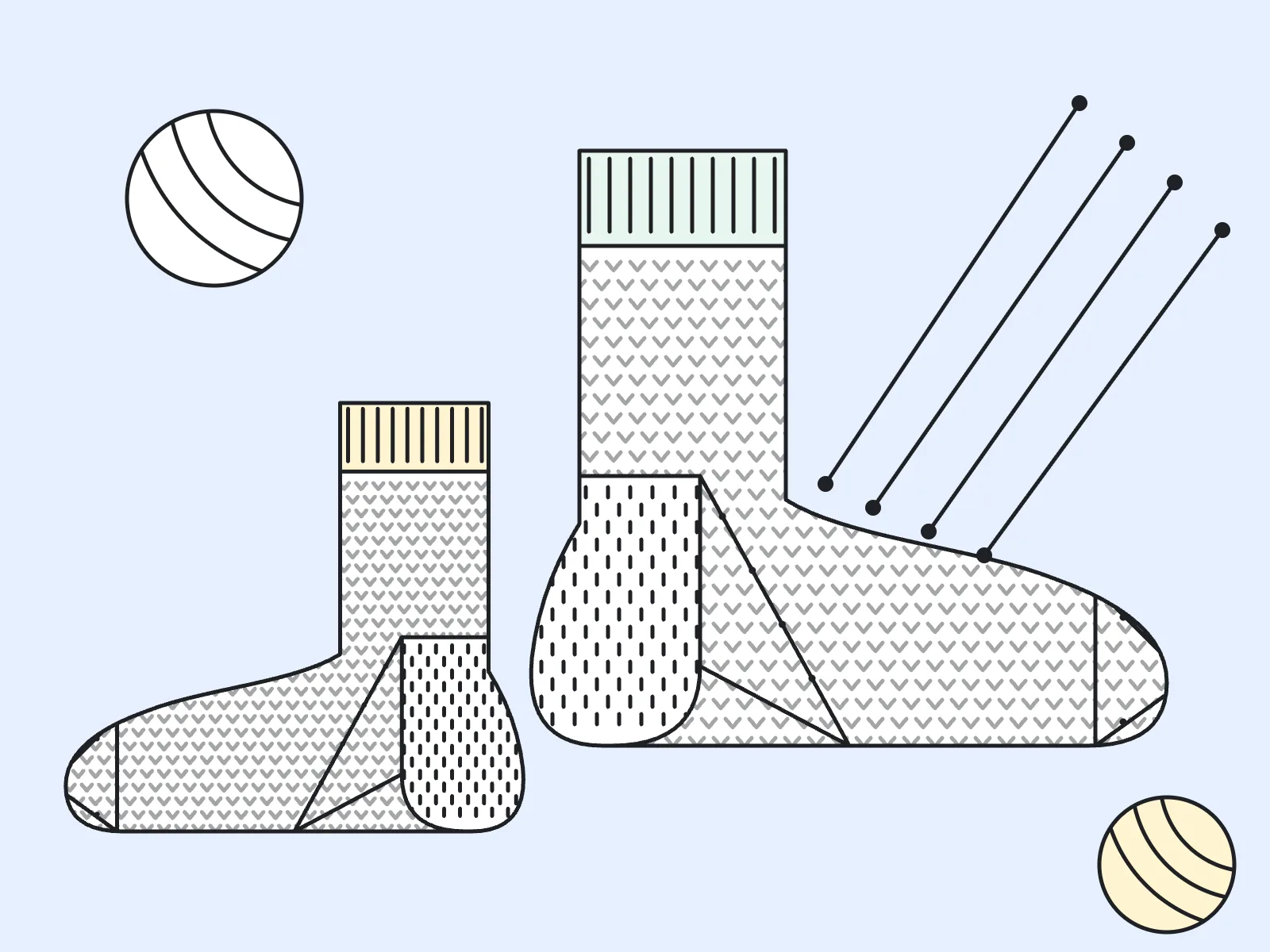
Cuff down means you knit from the top edge toward the toe. Here is the order you will work, so the pattern below makes sense at a glance.
- Cuff and leg: worked in the round over all 64 sts.
- Heel flap: worked back and forth over the first 32 sts, with slipped stitches along the edge.
- Heel turn: short rows that shape the cup of the heel and leave 18 heel sts.
- Gusset: you pick up stitches along both sides of the flap, then decrease back to 64 sts.
- Foot: plain rounds to the toe.
- Toe: a wedge shape with decreases on both sides, closed with grafting.
The free sock knitting pattern, row by row
The heel flap and gusset are where most knitters want every row spelled out, so here they are exactly as they are in the PDF. The cuff and leg are rounds. The heel flap and turn are numbered rows.
- Cast on 64 sts loosely. Place a marker and join to work in the round, taking care not to twist the stitches.
- Cuff. Rounds 1–16: *K2, p2; rep from * around.
- Leg. Rounds 17–60: Knit.
- Heel flap. Row 61 (RS): Working over the first 32 sts only, *slip 1 purlwise with yarn in back, k1; rep from * 15 more times. Turn. (32 heel sts)
- Heel flap. Row 62 (WS): Slip 1 purlwise with yarn in front, purl to the end of the heel sts. Turn.
- Heel flap. Rows 63–92: Work 15 more repeats of the last 2 rows.
- Heel turn. Row 93 (RS): Sl1, k17, ssk, k1. Turn, leaving 11 sts unworked.
- Heel turn. Row 94 (WS): Sl1, p5, p2tog, p1. Turn, leaving 11 sts unworked.
- Heel turn. Row 95 (RS): Sl1, knit to 1 st before the gap, ssk, k1. Turn.
- Heel turn. Row 96 (WS): Sl1, purl to 1 st before the gap, p2tog, p1. Turn.
- Heel turn. Rows 97–104: Work 4 more repeats of the last 2 rows.
- Heel turn. Row 105 (RS): Sl1, knit to 1 st before the gap, ssk. Turn.
- Heel turn. Row 106 (WS): Sl1, purl to 1 st before the gap, p2tog. Turn. (18 heel sts)
- Gusset. Round 107: K18 heel sts, pick up and knit 16 sts along the side of the heel flap, pm, k32 instep sts, pm, pick up and knit 16 sts along the other side of the flap. This is the new start of the round. (82 sts)
- Gusset. Round 108: Knit to 3 sts before the first marker, k2tog, k1, sm, knit to the next marker, sm, k1, ssk, knit to end. (80 sts)
- Gusset. Round 109: Knit.
- Gusset. Rounds 110–125: Work 8 more repeats of the last 2 rounds. (64 sts)
- Foot. Rounds 126–169: Knit.
- Toe. Round 170: Knit to 3 sts before the first marker, k2tog, k1, sm, k1, ssk, knit to 3 sts before the next marker, k2tog, k1, sm, k1, ssk, knit to end. (60 sts)
- Toe. Round 171: Knit.
- Toe. Rounds 172–183: Work 6 more repeats of the last 2 rounds. (36 sts)
- Toe. Rounds 184–188: Work the decrease round only, every round. (16 sts)
- Finishing: Arrange the stitches so the 8 instep sts are on one needle and the 8 sole sts on another. Cut the yarn, leaving a 12 in (30 cm) tail, and graft the toe closed (Kitchener stitch).
- Finishing: Weave in the ends, closing any holes at the corners of the gusset.
How to turn a heel: the heel turn explained
The heel turn is the part that scares people, and it is only short rows. You work part of the way across, decrease, turn, and come back. Each row ends with a decrease, so the heel flap's 32 sts come down to 18 over the 14 rows from Row 93 to Row 106.
Rows 93 and 94 do the first turns. Each one stops short and leaves 11 sts unworked. From Row 95 on, every row follows the same rule: slip 1, work to 1 st before the gap, decrease, and turn.
The gap is the little gap left where you turned on the row before. On a knit row the decrease is an ssk. On a purl row it is a p2tog. Rows 95 and 96 add one more stitch after the decrease, and the last two rows, 105 and 106, do not.
Take it a row at a time. When you finish Row 106 you have 18 heel sts and the cup of the heel is formed.
Tips for the heel flap and gusset
A few small things keep the heel flap and gusset tidy.
- Slip the first stitch of every flap row purlwise. With yarn in back on RS rows and in front on WS rows, it makes a neat edge to pick up from.
- Count your heel sts. You should have 32 after Row 61 and 18 after Row 106.
- At Round 107, check your count: 18 heel sts, 16 picked up, 32 instep, 16 picked up gives 82 sts.
- After the gusset decreases you are back to 64 sts. If you are not, check your decrease rounds.
- Mark the start of the round and place the other 2 markers where the pattern says. The decreases in the gusset and the toe are placed by the markers.
- When you graft the toe with Kitchener stitch, keep the tail at 12 in (30 cm) so you have enough yarn.
- Close any holes at the corners of the gusset when you weave in the ends.
Following it in Row & Round
Row & Round is an iPhone and iPad app for following knitting and crochet patterns. Open this PDF in it and a highlighter bar sits on the row you are working. In Row & Round the bar walks you through the heel flap, the turn and the gusset one row at a time. Tap +1 and the count and the bar move down together.
The heel flap is one pair of rows repeated 15 more times, which is easy to lose track of. Link a repeat counter to a pattern row, and the row goes back to 1 each time the repeat goes up. For the gusset you can set an alert on a counter, with a short note such as decrease round, so a banner shows when it is due.
If you change the foot length, set the count to the first toe round when you start the toe. The page window shows the few lines around your row, and your place is saved on every tap, so you can put a sock down mid-heel and find your row again.
Questions
- Is this a free sock knitting pattern?
- Yes. The Footpath Socks pattern is free for personal use: © 2026 Row & Round · Free for personal use. The full written instructions are on this page.
- Is it a good first socks knitting pattern?
- It is marked intermediate and written as a first pair. The heel is the new part, and every row of it is written out, so you can take it one row at a time.
- How much yarn do I need?
- About 380 yds (350 m) of fingering-weight (#1) sock yarn with some nylon for the pair. Use US 1½ (2.5 mm) double-pointed needles or a long circular.
- How big are the socks, and can I change the foot length?
- They are one size, about 8 in (20 cm) around the foot, with a foot about 9½ in (24 cm) long. To change the length, work more or fewer plain foot rounds, about 11 rounds to the inch.
- How do I turn a heel?
- Work short rows over the 32 heel sts. Each row stops 1 st before the gap, makes an ssk or a p2tog, and turns. By Row 106 you have 18 heel sts.
- How do I close the toe?
- Put 8 instep sts on one needle and 8 sole sts on another, leave a 12 in (30 cm) tail, and graft the toe closed with Kitchener stitch.