
Five 1840s edgings, rewritten for today's needles
Victorian lace edging patterns are narrow knitted strips made to be sewn onto cuffs, collars and linen, and this book holds five of them, adapted from two books published in 1846 and 1848. Each has written rows, a chart and modern yarn and needle sizes.
- Knitting
- 5 patterns
- $4.99 in the app
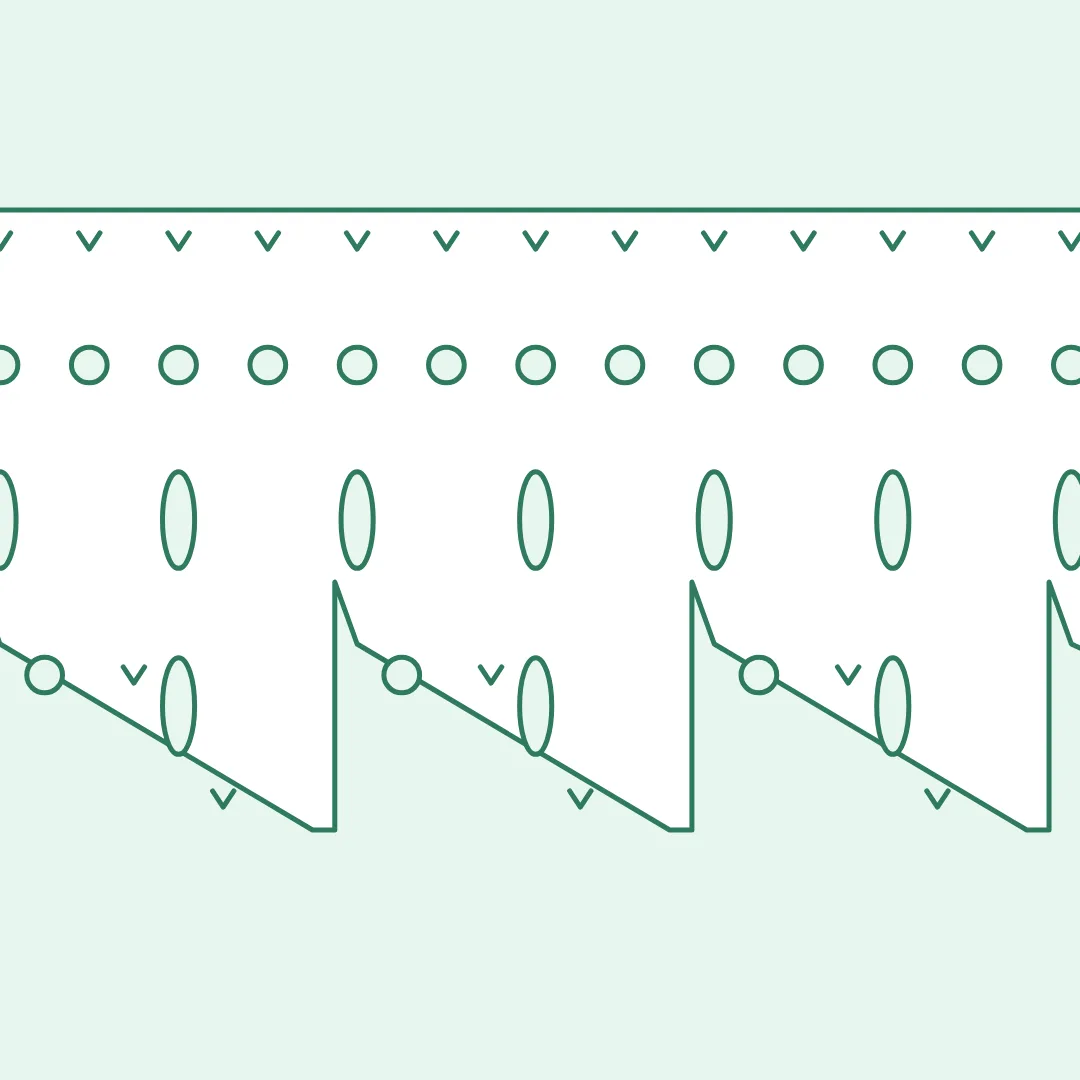
What’s in Victorian Lace Edgings
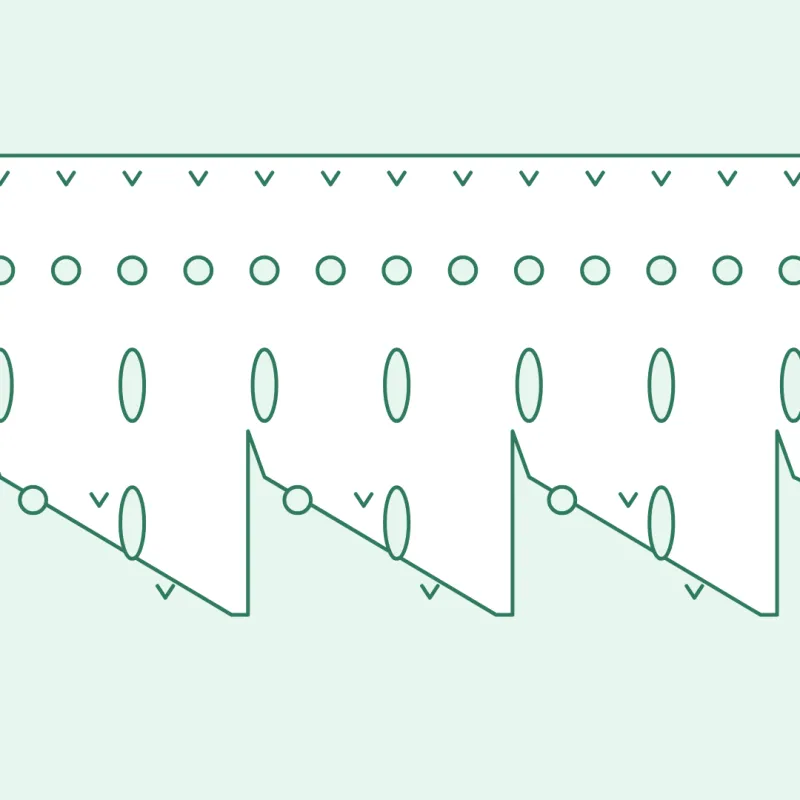
Vandyke Edging
Narrow garter-stitch strip with eyelets and small pointed vandykes. Easy. About 1.5 in (3.8 cm) deep in fingering weight yarn on US 2½ needles.
Easy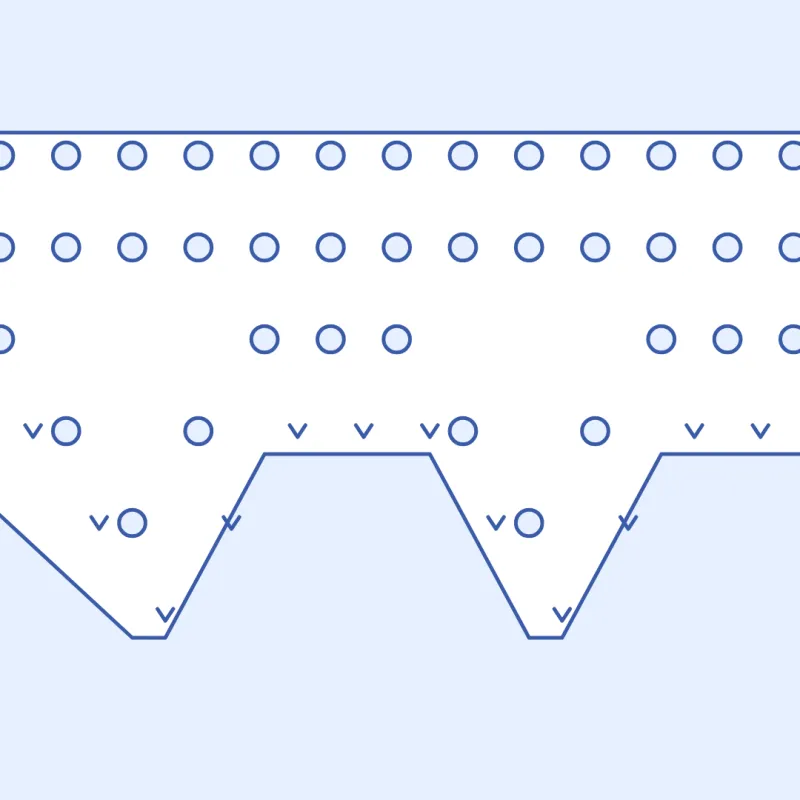
Diamond Edging
Garter stitch with a small diamond of yarn-overs beside an eyelet heading. Easy. About 1.3 in (3.3 cm) deep in size 10 crochet cotton.
Easy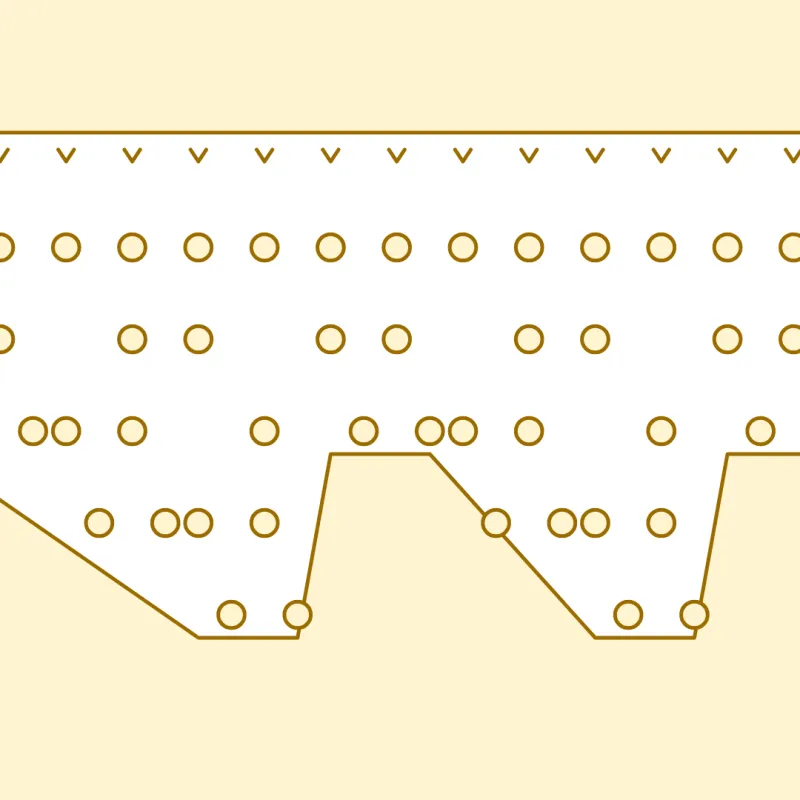
Treble Diamond Edging
Stacked yarn-over diamonds around centred double decreases, with a zigzag outer edge. Easy to Intermediate. About 1.3 in (3.3 cm) deep in crochet cotton.
Easy to intermediate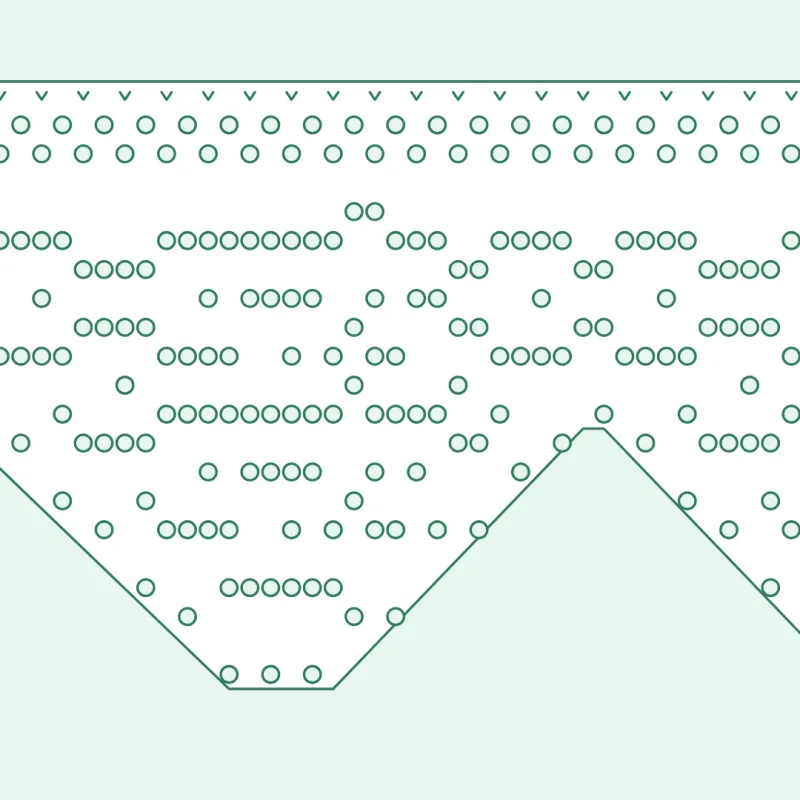
Point Lace Edging
Diagonal lines of paired eyelets build a deep point over 30 rows. Intermediate. About 2.5 in (6.3 cm) deep in size 10 crochet cotton.
Intermediate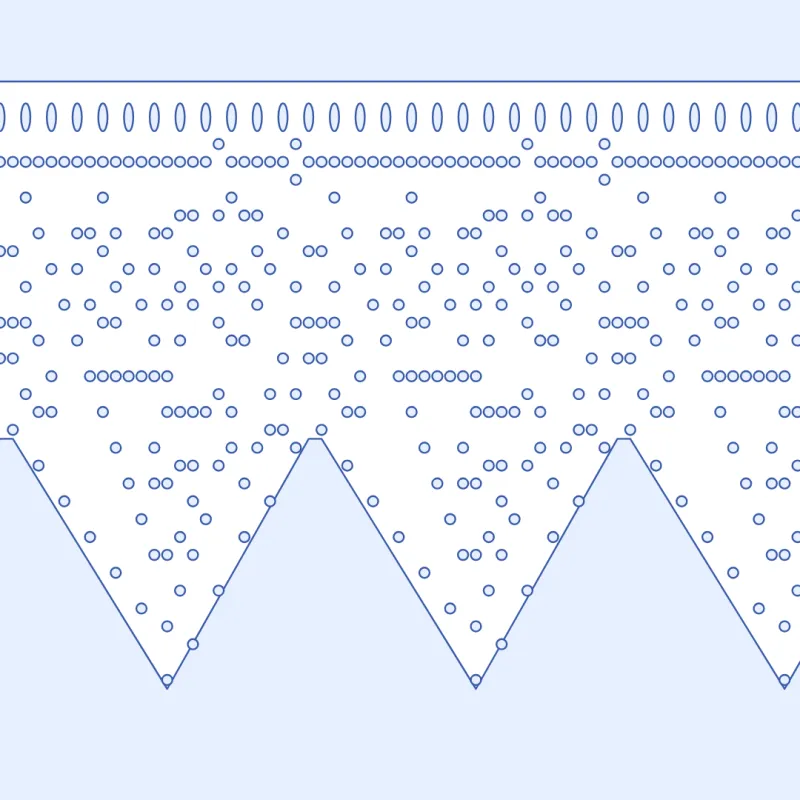
Chantilly Lace Edging
A broad openwork triangle with large holes along the straight edge, growing from 21 to 34 stitches. Advanced. About 4.0 in (10.2 cm) deep in crochet cotton.
Advanced
Open the pattern book in Row & Round
Victorian Lace Edgings is a pattern book in the Row & Round app: $4.99, a single purchase that is yours to keep. Other countries see their local price.
Which edging to cast on first
The five run from 6 stitches on the needle to 34, and the difficulty climbs with them. Vandyke and Diamond are both Easy: garter stitch, a few yarn overs, a decrease or two. Treble Diamond sits one step up, because the lace now needs a second look on the wrong side as well.
Point Lace is Intermediate. Its 30-row repeat has eyelets on both sides of the work, so no row lets you coast. Chantilly is Advanced and earns the label.
None depends on another. If you knit lace already, go straight to the one you want to see on a pillowcase. If you don't, work upward and the stitches will be familiar by the time the rows get long.
Vandyke, and the ten points a sleeve
The 1846 book ends its Vandyke Edging with a line of pure shopping list: "For each sleeve 10 Vandykes are required." The strip was meant for a pair of undersleeves, in white Berlin wool on pins No. 11. Here it becomes fingering weight yarn on 3.0 mm needles.
The point is made by row 8, which the book words as "Cast off all but 6 stitches, knit them plain, and commence at 1st row." In this version that reads BO 4 sts, k to end: ten stitches less four leaves the six you cast on with. The step back is abrupt, which is exactly what gives each point its sharp tip.
Row 5 asks for the odd instruction of the old books, and the same page defines it: "To make 2 stitches is to put the wool twice round the pin." Today that is a double yarn over, and on the next row the purl goes into the second wrap.
The missing yarn over in Diamond Edging
Typed out as printed, row 1 of the 1846 Diamond Edging comes to six stitches. Row 3 needs seven. Somewhere a yarn over fell out of the printing.
The fix here is to put a yarn over before the k2tog, which makes row 1 identical to row 11. With that one change every row uses exactly the stitches on the needle, and the 12-row repeat lands back on 7. You will notice the edging is oddly calm: the right side carries all the lace and every wrong-side row is knit, so the missing stitch is the most dramatic thing in the pattern.
It is a reading, and the history notes say so plainly rather than pretending the book was clear.
The slipped stitch the books never wrote down
Both books share a house rule, and neither prints it in the rows. The 1848 edition puts it this way: the first stitch of every row is slipped, "this is not mentioned in the receipts, as it would much lengthen the description." So a row that begins "Knit 2" starts here with Sl1, k1, and a row that begins with a yarn over stays as it is, since you cannot slip a stitch you have not made yet.
The old books also love a shortcut. Treble Diamond's even rows read "Same as 2nd", and Point Lace rows 21 and 27 say "Same as" something earlier "but ending" differently. Read literally, row 21 does not balance. The pattern book replaces the last "knit 3, make 1, knit 3" of row 13 with k2tog, k2, which uses exactly the 19 stitches on the needle and leaves the 17 that row 22 wants.
The same page advises: "Many ladies in working a pattern, copy on cards each row separately; this prevents confusing one row with another." Writing every row out in full is the same idea, done once for you.
Point Lace is the pattern where this matters most. Around row 21 the count starts falling, 19 to 17 to 16, and a bar parked on that row in Row & Round saves you recounting after a tea break.
Chantilly, from 21 stitches to 34 and back
Chantilly Lace Edging is printed in the 1848 book as the second part of a berthe, with the remark that it "may be used for a variety of purposes." Worked alone, it is a 24-row repeat that swells from 21 stitches to 34 on row 14, then decreases by one or two a row until it is back to 21.
Its signature is the double yarn over. The book tells you to pearl one and knit one into the wraps on the following row, and the rows already spell it out as knit 2, pearl 1, knit 1 at the end. Those wrong-side rows are fiddly and worth doing slowly; they are where the large holes along the straight edge come from.
Every right-side row begins with a decrease, which the 1848 rule turns into a slipped stitch, a knit stitch and a pass-over. No row needed correcting. The printed text balances as written, which is rare enough in a book of this age to be worth saying.
Yarn, needles and how deep each edging comes out
Vandyke takes fingering weight (4-ply) wool or cotton on US 2½ (3.0 mm) needles. The other four are happiest in size 10 crochet cotton, or a lace-weight cotton, on US 1 (2.25 mm) needles. All are worked flat on a pair of straight needles. Add a tapestry needle and rust-proof pins for blocking.
Depth is about 1.5 in (3.8 cm) for Vandyke, 1.3 in (3.3 cm) for Diamond and Treble Diamond, 2.5 in (6.3 cm) for Point Lace and 4.0 in (10.2 cm) for Chantilly. Gauge is not critical here: a finer yarn gives a narrower edging, a heavier one a wider one. Yardage below is an estimate per yard (36 in / 91 cm) of finished edging.
- Vandyke: about 70 yd
- Diamond: about 70 yd
- Treble Diamond: about 75 yd
- Point Lace: about 135 yd
- Chantilly: about 210 yd
Questions
- How do I know when to stop knitting an edging?
- Finish on the last row of a repeat, when you are back to the cast-on count: 6, 7, 7, 12 or 21 stitches depending on the edging. Bind off loosely, then block it before measuring against your project.
- Can I use ordinary yarn instead of crochet cotton?
- Yes, but the edging changes size with it. A heavier yarn gives a wider, looser strip, and the yardage estimates will no longer apply. Choose needles that give a firm but open fabric.
- Why do some rows start with a yarn over?
- A yarn over at the start of a row cannot be slipped, so those rows are written as they were printed. The slipped first stitch is applied only to rows that begin with a knit.
- What is sk2p?
- Slip 1 knitwise, k2tog, then pass the slipped stitch over. The 1840s books call it "knit 3 together" and describe the same movement.
- How do I attach a finished edging?
- Wet-block it, pinning the straight edge in a line and each point out. Then sew the straight edge on with small whip stitches, easing in a little extra at corners.
Open the pattern book in Row & Round
Victorian Lace Edgings is a pattern book in the Row & Round app: $4.99, a single purchase that is yours to keep. Other countries see their local price.