
Six old caps and tams, rewritten for yarn you can buy now
This pattern book collects six vintage hat knitting patterns, four to knit and two to crochet, from 1890, 1917 and 1920. Each is rewritten for today’s worsted and DK wool in three sizes, with the gauge the old pages never gave. The shapes stay as they were drawn.
- Knitting and crochet
- 6 patterns
- $4.99 in the app

What’s in Vintage Caps & Tams

Knitted Tam o’Shanter
A flat star-topped tam grown from 8 stitches at the centre, narrowing to a twisted-rib band and finished with a tuft. Intermediate, sizes S, M and L.
Intermediate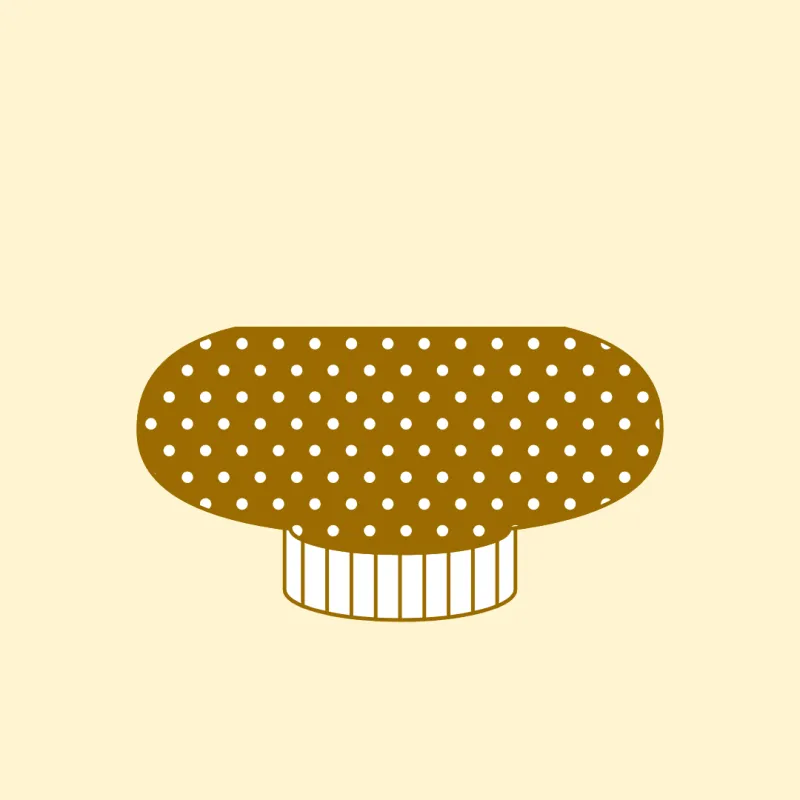
Two-Colour Crochet Tam
A flat crochet tam with colours swapped on every stitch for a fine speckle, then a knitted 1×1 rib band. Intermediate, sizes S, M and L.
Intermediate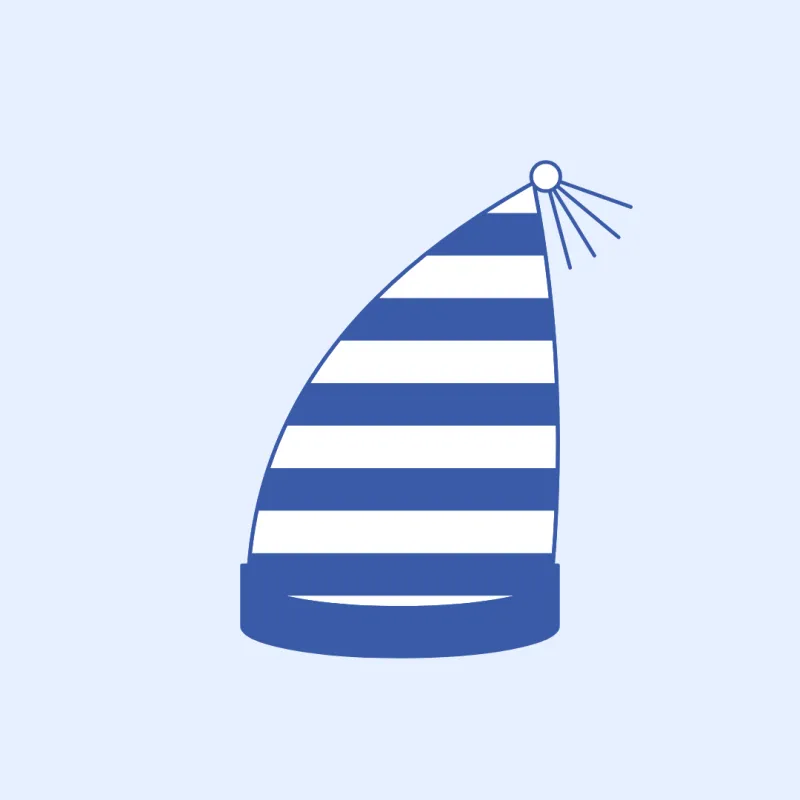
Fisherman’s Stripe Cap
A long cap in 8-round stripes with a doubled hem, four decrease lines to the point and a two-colour tassel. Easy, sizes S, M and L.
Easy
Crochet Pillbox Cap
A flat-topped double crochet cap with a crisp back-loop edge, a straight band and a small rosette. Between easy and intermediate, sizes S, M and L.
Easy to intermediate
Ribbed Watch Cap
A deep knit 2, purl 2 cap from a 1917 book, with a crown that narrows along purl lines. Brim folded up. Easy, sizes S, M and L.
Easy
Child’s Sailor Tam
A child’s tam with a doubled turquoise-style rib band, garter-ridge square top and a large pompom. Between easy and intermediate, three child sizes.
Easy to intermediate
Open the pattern book in Row & Round
Vintage Caps & Tams is a pattern book in the Row & Round app: $4.99, a single purchase that is yours to keep. Other countries see their local price.
The tam that starts as a point and grows into a star
M. Elliott’s 1890 Tam o’Shanter opens with 4 stitches on 4 needles and one man’s head in mind. The increase gets a single sentence: knit 2 in each stitch, and before you drop it, “take up the back part and knit a stitch on it”. That is kfb, and it is the only increase in the hat.
The original then increases every 3rd stitch, every 4th, every 5th and on up to every 11th, with longer and longer runs of plain rounds between, all at 12 stitches to the inch. In worsted, that spacing would not keep the top flat. Here eight increases fall every other round and stack into eight straight lines, so the crown lies as a star and measures about 10¾ in across in every size. The 20 plain rounds at the widest point shrank to 8 (Rounds 41 to 48), and the underside decreases mirror the crown.
Only Round 65 knows which size you are. S, M or L, it sets 88, 96 or 104 stitches for the twisted-rib band; everything before it is identical, which means the crown can be started before you settle on a size. In Row & Round the bar reaches that round at the point where the three sizes finally part.
M. Elliott blocked it on a round of stiff cardboard, damped and left to dry, and lined it with thin silk. You block over a dinner plate of 10 to 11 in (25 to 28 cm) instead, with the band hanging below the rim, and skip the lining. The tuft is yarn wound about 40 times round a 1½ in card.
Two hundred and sixty stitches and a stripe called black
The fisherman’s cap in the same 1890 book casts on 260 stitches, on No. 17 needles, in fine merino or 2-fold silk, and knits stripes of 16 rounds. Rewritten for DK wool at about 5½ stitches to the inch, it becomes 104 [112, 120] stitches and stripes of 8 rounds. The plain section before the decreases runs 56 rounds.
The decrease instructions open under the heading “Black stripe”, on a cap that is red and gold. We took it as the next stripe in whichever colour is due and kept the stripes going to the tip. Four sections each decrease with k2, k2tog at either end, and the second decrease is worked as an ssk so every pair mirrors. The old page thins the decreases from every 4th round to every 3rd to every other; here it is every 4th round four times, every other round six times, then two rounds of k2tog. Larger sizes finish with a few more stitches at the tip, 6, 8 or 10.
The old page also tells you to knit a square of 20 stitches, measure it, and multiply by the head. That is gauge, 1890 style. The hem is doubled and folded, the tassel takes both colours, and the finished cap runs about 8½ in (21.5 cm) from the fold to the tip.
Two crochet hats, and a cord we left out
The Two-Colour Crochet Tam swaps colour on every stitch from Round 4: one stitch in A, the next in B. The colour you are not using travels along the top of the round below and gets worked over, so it hides inside the stitches, and you change on the last pull-through of the stitch before. The effect is a fine speckle. The top is a spiral, rounds not joined, with a marker to keep your place. The old text kept going until the work was 16 in across; this one stops at 10¾ in. The knitted band is picked up with one stitch in each single crochet and ribbed 1×1 for 20 rounds, as the original does.
The Crochet Pillbox Cap is the 1890 book’s bicycling cap. The original is worked entirely over a knot of mohair cord held along the edge, which gives the raised, firm shape. We left the cord out, and Round 9 goes into the back loops only to make the crisp line between crown and band. The band is the original’s: 9 rounds with no increases, then 2 of single crochet, about 4 in (10 cm) deep.
Both patterns use US terms. The old book’s double crochet is sc here, its treble is dc, and the rosette’s “long” and “double long” are tr and dtr. The rosette has one quirk worth knowing: the 1890 text numbers its rounds 1 to 4 and then 6, with no 5th. Here they run in order. The linen and leather lining became an optional ribbon one.
A watch cap from a few lines of 1917
The original is barely a paragraph in a 1917 knitting book edited by Olive Whiting: “Set up 96 stitches (32 on each of 3 needles). Knit 2, purl 2 for 8½ inches.” Then the crown: purl the first stitch of each needle, knit the next two together, rest plain, and “Draw your wool through the stitches and pull up.”
That 96 is our size M. S is 84 and L is 108, and the ribbing runs 60 rounds in all of them. The crown keeps the old trick: each of the three sections carries a purl stitch up the decrease line, so the shaping reads as three neat ridges. The old text goes on until 6 stitches remain on each needle. To keep the round numbers the same in every size, this version works 22 decrease rounds and closes with two rounds of k2tog, so M ends on 8 stitches rather than 18.
Worn with the brim folded up about 3 in (7.5 cm), the cap is about 11½ in (29 cm) long. The circumference, measured with the ribbing gently stretched, is 16¾ [19¼, 21½] in. Worsted wool, about 200 [230, 260] yd, and nothing more complicated than knit 2, purl 2.
A child’s tam, worked the other way up
The 1920 booklet starts with the top. Cast on 50 stitches, knit to 10 inches “making a square”, pick up around all four sides, 67 stitches on each of 3 needles, knit 13 rows, narrow twice, then work a doubled turquoise band and add a “large pom pom”.
This version flips the order so everything is in the round and nothing is picked up. You begin with the band: 12 rounds of knit 2, purl 2 in the contrast colour, 2 plain rounds for the turn, 12 more rounds of rib, so the band folds double. Then come the increase rounds, which replace the original’s two narrowing rows because you are going the other way, and 13 plain rounds. The square top is a mitred square closed at four corners, and the purl ridges still give it the look of garter stitch.
The first corner decrease arrives on Round 44, and in Row & Round that is where the bar sits when the square starts to close, down to 4 stitches by Round 89. Only the band changes between the three child sizes. The top is about 9½ in (24 cm) square for all of them.
Which hat first, and what to buy
For a first cast-on, the Fisherman’s Stripe Cap and the Ribbed Watch Cap are easy: plain knitting with a colour change every 8 rounds in one, knit 2, purl 2 in the other. The Crochet Pillbox Cap and the Child’s Sailor Tam sit between easy and intermediate. The Tam o’Shanter and the Two-Colour Crochet Tam are intermediate, because the crown shaping and the colour work ask for attention.
Adult sizes S, M and L fit heads of about 20, 21½ and 23 in (51, 54.5 and 58.5 cm). The child’s tam fits about 18, 19½ and 20½ in (46, 49.5 and 52 cm), roughly ages 2–4, 4–8 and 8–12. Ribbed bands are made 1 to 3 in smaller than the head and stretch to fit. Gauge runs from 19 to 22 stitches over 4 in (10 cm), so swatch before you commit; a tam’s top grows with your gauge. Needles run from US 4 to US 7, the crochet hook is a US G-6 (4.0 mm), and amounts below are about figures.
- Tam o’Shanter: worsted wool, about 260 [265, 270] yd, plus a few yards of contrast for the tuft.
- Two-Colour Crochet Tam: DK wool, about 290 [295, 300] yd in A and about 210 yd in B.
- Fisherman’s Stripe Cap: DK wool, about 115 [125, 135] yd and about 105 [115, 125] yd.
- Crochet Pillbox Cap: DK wool, about 140 [150, 160] yd, plus about 20 yd for the rosette.
- Ribbed Watch Cap: worsted wool, about 200 [230, 260] yd.
- Child’s Sailor Tam: worsted wool, about 245 yd in the main colour and about 70 [75, 80] yd in the contrast.
Questions
- Can I use a different yarn weight from the one listed?
- You can, but the stitch counts will not follow. Every count was built for the stated gauge, 19 to 22 stitches over 4 in (10 cm) depending on the hat, and a tam’s top grows or shrinks with yours. Swatch and measure first.
- Why do all three sizes of the Tam o’Shanter have the same top?
- The first 64 rounds are identical in S, M and L, so the top is about 10¾ in (27 cm) across whatever you choose. Only Round 65 and the twisted-rib band change the stitch count.
- How do I hide the second colour in the crochet tam?
- Alternate one stitch in A and one in B, carry the unused colour along the top of the round below and work over it. Change colour on the last pull-through of the stitch before.
- Why does the watch cap have purl stitches running up the crown?
- The 1917 original says to purl the first stitch of each needle, knit the next two together and knit the rest plain. Each purl stitch becomes a ridge along a decrease line.
- Are the old crochet terms the same as US terms?
- No. The 1890 book’s double crochet is single crochet (sc) here, and its treble is double crochet (dc). The patterns use US terms throughout.
Open the pattern book in Row & Round
Vintage Caps & Tams is a pattern book in the Row & Round app: $4.99, a single purchase that is yours to keep. Other countries see their local price.